
Activity: Introduction to the SDGs | Duration: 40 mins
The aim of this activity is to familiarize participants with the goals and prompts them to think about how these goals affect their communities and the world.
Introduction: Ask participants what they already know about the Sustainable Development Goals. Play one of the videos introducing the Sustainable Development Goals. Or you can explore each goal using these online slides.
Discussion:
The Sustainable Development Goals are …
- A set of 17 goals for the world’s future through 2030
- Backed up by a set of 169 detailed targets
- Consulted widely on. Read what Irish young people had to say about what the goals should be back in 2014. Dublin-Declaration-on-Children-and-Youth
- Negotiated over a two-year period at the United Nations, with Ireland co-facilitating the negotiations alongside Kenya.
- Agreed to by nearly all the world’s nations, on 25 Sept 2015
- Universal and apply to every nation, every sector of society and every citizen. Cities, businesses, schools, organizations, all are challenged to act.
- Integrated and interdependent. One goal cannot be achieved without the others. You cannot end poverty (Goal 1) without ending inequality (Goal 10), providing for education (Goal 4), well being (Goal 3) and ensuring people have decent jobs (Goal 8) etc.
Key to the goals is the word sustainable. This means development that meets the needs of the present without compromising the ability of future generations to meet their own needs.
193 Member States of the United Nations reached consensus on the outcome document of a new sustainable development agenda entitled, “Transforming Our World: The 2030 Agenda for Sustainable Development”. This agenda contains 17 goals and 169 targets and will be achieved in 2030 using a set of indicators developed with the help of national statistic offices.
The Goals and targets are centred around: people, planet, prosperity, peace and partnership.
- People, as we are determined to end poverty and hunger, in all their forms and dimensions, and to ensure that all human beings can fulfil their potential in dignity and equality and in a healthy environment.
- Planet, to protect the planet from degradation, including through sustainable consumption and production, sustainably managing its natural resources and taking urgent action on climate change, so that it can support the needs of the present and future generations.
- Prosperity, to ensure that all human beings can enjoy prosperous and fulfilling lives and that economic, social and technological progress occurs in harmony with nature.
- Peace, to foster peaceful, just and inclusive societies free from fear and violence. There can be no sustainable development without peace and no peace without sustainable development.
- Partnership, to mobilize the means required to implement this Agenda through a revitalised global partnership for sustainable development, based on a spirit of strengthened global solidarity, focussed in particular on the needs of the poorest and most vulnerable and with the participation of all countries, all stakeholders and all people.
The goals are universal, meaning every nation must take on to achieve them and must help others to do the same. This means Ireland must implement their national plan to achieve these goals by 2030.
Group Work: Divide participants into smaller groups to explore the Sustainable Development Goals. Ask them to identify one goal that is important in their life, one goal that affects their community, and the goal that they think will be most challenging for the global community to solve.
Feedback: Ask participants to share the goals they identified and give their reasons for their choices. Ask participants what they think they can do in their own lives to help achieve the Goals by 2030.
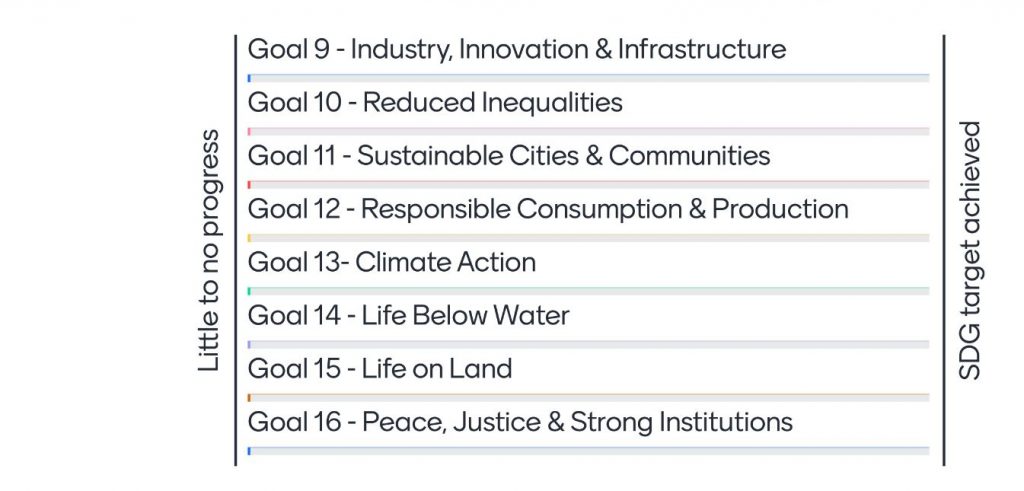
The aim of this activity is for participants to consider the progress of the SDG as of 2020. It then prompts learners to think about the interconnectedness of the
SDGs.
Discussion: Ask participants which goals they think will are on track to meet their 2030 targets and which goals are behind schedule. Ask them how the Covid pandemic has impacted on the Goals. (3-5 minutes) Watch the video below (10 minutes) and continue the discussion.
- Did any information surprise you?
- Why do you think some goals have hit their targets while others have not?
- What needs to be done to help reach targets?
Group Work: Start by watching the second video below, on life in a remote village in South Sudan. Divide participants into smaller groups, ask them to choose three Goals and discuss their interconnectedness. Ask them to determine how a lack of progress in one goal might impact on the other two. For example, how Poverty, Gender, and Climate affect each other. Ask participants to consider based on their discussions, the difference in impact between children and adults. For example, how might a climate-related, natural disaster impact on a child’s life versus and adults life? Learn more about the ways in which children rights are interconnected to the SDG’s with this interactive map.
Extension: Take the Gapmider test, to find out what you know about the SDGs and what are misconceptions.
Activity: Ireland’s Action on the Goals | Duration: 40 mins
The aim of this activity is for participants to evaluate Ireland’s progress on achieving the Sustainable Development Goals.
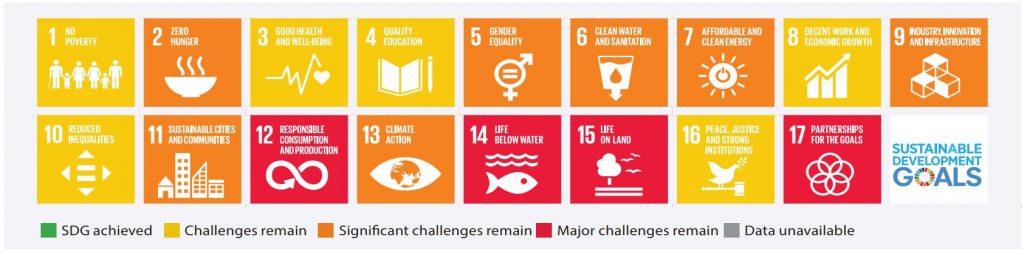 Ireland’s SDG Dashboard Source: 2019 Europe Sustainable Development Report p.90
You will need the 2019 Europe Sustainable Development Report pages 90-91 (Ireland’s Report) and a room with space or the use of Mentimeter if working online.
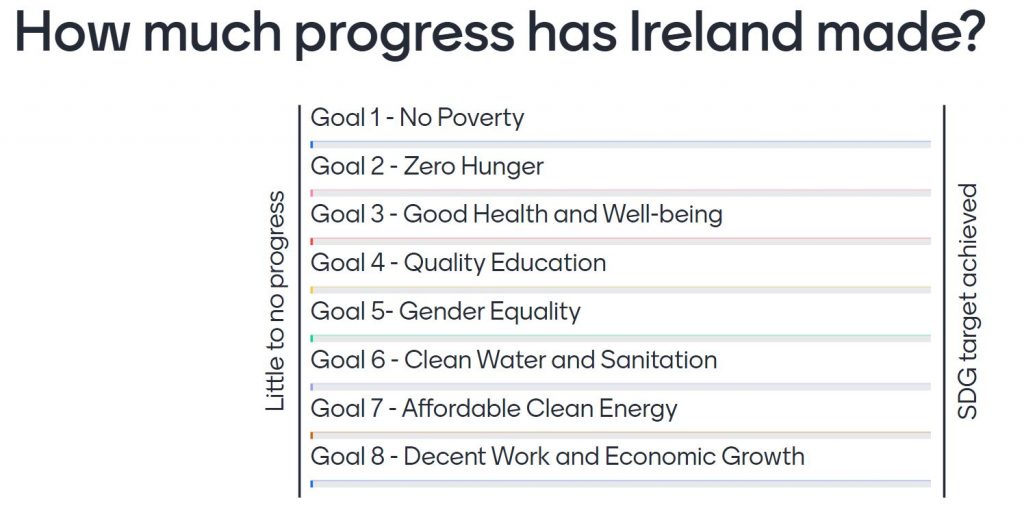
Activity: Assessing the Goals. Ask participants to take a moment and think about each of the 17 Goals and how they relate to Ireland. If in class together get students to line up in the middle of the room/space (hallway or meeting space) and walk toward one wall based on how well they feel Ireland has progressed in achieving each goal. Please note, if they feel Ireland is falling behind on the goal they can also step backwards. If you are delivering the class online use Mentimeter.com and create slides similar to below. With each goals assessment, ask the participants to share their reasoning, particularly those people who are optimistic and pessimistic at the front and at the back of the room.
Group Work: Divide participants into pairs and assign each pair with a Goal. Hand out the progress report for Ireland with performance indicators for each Goal. Ask participants to analyse the targets/indicators in assessing why Ireland is doing well or not so well. Ask participants to consider the indicators and whether or not they offer an accurate reflection of achievement under that Goal. Ask participants to think of other indicators that would better reflect Ireland’s performance in achieving the Goal.
Feedback: Ask for feedback for each goal, gather reflections on the indicators: Did any of the indicators or outcomes surprise you? Why were these indicators chosen to measure progress? Are these the same indicators used globally or just in the EU, why/why not? Should wealthier nations set higher targets or use different indicators than poorer nations? Who should be involved in deciding what indicators are used the measure progress? Should children and young people have their own set of indicators? For more information about indicators for the wellbeing of children read UNICEF’s Report on Children and the Sustainable Development Goals
Extension: Go to Ireland’s SDG data hub to allow for more in-depth analysis and exploration of Ireland’s indicator data sets.

At current rate of progress, between now and 2030,
Video: Are we on track to meet our targets? For discussion
Video: How interconnected are the goals? For group work
Video: (34 minutes)
Reflection: Ask participants to help make this a decade of action to achieve the Goals by 2030. Ask participants to reflect on their learning and…
- Choose an issue they wish to focus on as a changemaker.
- Make a personal pledge – one goal/action to undertake for the next year to achieve change for the chosen issue.
- Devise indicators that will show progress
- Set three dates for assessing and monitoring progress.